
"The Hunchback of Notre Dame" was certainly a classic, but it could never have achieved that title without Lon Chaney. It takes great skill to act a character with only three lines, and still have the audience notice you. The physical job of Lon Chaney's acting was incredible. He had it down! Everything, from the jumping up and down frantically, to the sharp toothed scowl as he perched on the walls of the cathedral, pointing and shaking his fist accusingly. It was all there, and with all of that it still didn't seem as though he was the main character. The film plays out from different points of views. You have the cathedral's point of view, which includes Quasimodo and Dom Claude , the peasants point of view, which includes Clopin and Esmeralda, and finally the (Government's?) point of view, which includes the court, Phoebus, and (sort of) Esmeralda. During the climax, all of these story lines collide. It's a very effective technique to telling a story.

It doesn't focus too much on the Hunchback character, so much as the struggle of Paris society itself. People are hanged, there isn't too tight a grasp on the populous, and it's a bit too chaotic. As we begin to learn more about each of the characters, so does Quasimodo's hatred begin to divide into certain areas of the society, instead of the society itself. The music plays a part in the story telling as well, where the music gradually fits to the emotions of Quasimoto and less onto the rest of the population, as we begin to see that he isn't as evil as he looks. It is the less disfigured people that seem more dangerous.
Speaking of, "dangerous" and, "evil," lets talk about Jehan. This guy is the meanest @#!*% ever! He frames Quasimodo for a crime he was being forced to commit, he stabs Phoebus and thus frames Esmerelda for stabbing him in the back (literally), tries to get the court to, "ask the question," which I'll get into later, and finally kidnaps her to, "have his way with her!" Now that is pretty mean! I mean, look at him! He's right there, circled in red, with the red cape. Y'know how there are films that point out the villain almost instantly? That one guy, that's hidden under a thick layer of good guys? The one that's always telling the king what to do? The one wearing black and red.....the colors of EVIL? THAT is who this guy is!
 He's always lurking in the shadows, waiting to strike. Waiting in an alley, for the precise moment where he can trip an old lady holding her groceries, or throw an angry cat on a priest, or slap Lon Chaney around. He would do it! An everything so stupid, so revoltingly jerk-like, so backhandedly backstabbing, and so purely evil could not be place next to how humanly evil this one man is!!! ...Nawww! I'm just kidding! The best villain ever is probably the devil from, "A Night on Bald Mountain." But, I'm getting off track here.
 Lets now talk about, "The Question." This is the act of forcing a victim to confess to his/her crimes in a court of law...to put it lightly! What it basically is, is this: "Did you steal my chocolate, Bobby?" "Why no, Billy! I would never take someone's chocolate, you know that!" "Alright then, Bobby...I'm going to have to whip you until you confess the way that I want you to, okay?" "Sounds fair to me...OUCH!" WHY MIDDLE AGES?! WHY?! "The Question" is the stupidest thing I have ever heard of! "The act of forcing someone to confess in a court of law?!" What about evidence given to prove someone right or wrong? Doesn't that seem a little less...stupid?! I mean man! People in the middle ages were IDIOTS!
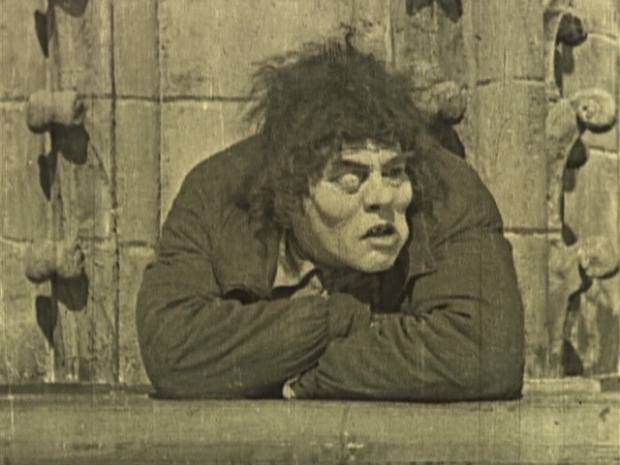
In conclusion, anyone in their right mind who has seen this film, probably already considers this a classic. It's all really great stuff, and Lon Chaney is more than just icing on the film flavored cake. I'm sure that the film wouldn't get the same credit that it does today, if Lon Chaney was not in this film. I'm sure it would still be good, but he makes it so much better. This is a very sad film, and ends on a bittersweet note. It has a, "Phantom of the Opera" feel, where the disfigured are hated and the people on the ground make a mockery of the filth below them. These two films are absolutely neck and neck when it comes to not only Lon Chaney's performance, but film itself. I don't know, but when it comes to playing a disfigured, mistreated person that hides in huge places like a cathedral, or an opera house, Lon Chaney is the man.
8.7/10
Next Review: A Night on Bald Mountain 1940


 Posts
Posts


.jpg)
