Pages

Total Pageviews

Showing posts with label 1950. Show all posts

Monday, November 5, 2012

Plan 9 From Outer Space: 1959


Release date: July 22, 1959 (USA)
Director: Ed Wood, Jr.
DVD release date: May 18, 1999
Screenplay: Ed Wood, Jr.
Sequel: Night of the Ghouls

     Lets talk a little bit about Ed Wood. This overly-optimistic director of several titles, was deemed the worst film director of all time. His movies are corny, they are campy, and although I do like Ed Wood and the name he has made for himself, the movies that he makes with the meager finance he is given, are just bad. But the person behind these films, "Glen or Glenda", "The Ghoul Goes West," and, of course, "Plan 9 From Outer Space," is the real story.

     
     Ed Wood was  an odd ball of sorts. Secretly a transvestite, Ed wood worked in Hollywood for a short time before signing over to screen classics, a studio which specialized in B-movies. He made his first film, Glen or Glenda which expressed his love for wearing women's clothing. This passion of his ruined the marriage with his first wife, but not his second. Befriending Bela Lugosi, who was currently a drug addict, made making films a bit easier for Ed, because in his mind Bela was still a star. Although appearing in many films, Bela's popularity died down drastically with the atomic age of films. This was a period in film history that was confined to the 50's, and consisted mostly of bugs that grew 50 feet tall and started destroying the tranquil city of fill in the blank. Ed Wood would continue to make B-movies with Bela, and eventually they became good friends. Supposedly during this time, Bela checked himself into rehab as one of the first celebrities ever to do so. Ed Wood would continue to make movies, and would later be dubbed, "The Worst Director of all Time." You can't get more depressing than that.

   Plan 9 From Outer Space is one of those movies that you don't necessarily dream about, more so that one movie that you don't believe exists until you watch it. You have, a science fiction film, that has implemented horror into it. Now, if it were to be done correctly, we may have a good film, or at least a decent one. Often times science fiction can become quite scary. This, however, is not one of those cases. In fact, very rarely would you come across a science fiction film that is also a horror film from the 50's. But that doesn't mean that they aren't out there. I think what Ed Wood may have been trying to do was put everything he liked into one movie, and this is one of the reasons that "Plan 9 From Outer Space" simply does not work. Alien's from another planet come to earth to execute "plan 9" which involves the resurrection of the dead. Why do they do this? I honestly could not catch onto their motives. In this sense the film can become apparently cryptic to some viewers, mainly me. At least we have the satisfaction of every character being on the same page as those that are watching them. 

   The editing for "Plan 9" is just one of the worst things I've seen in awhile. Normally editing in a film isn't something I talk about in a review, but I need to address this. Normally in a film,  the final product will create for itself a smooth transition from each and every shot. The purpose of editing is to create a seemingly fluent narrative for the viewers to comfortable watch a film in. "Plan 9" instead resorts to still shots one after the other in the same position almost every time. This is why, if you were watching this movie now-a-day's you would so bored you wouldn't know what to do with yourself. Because of this complete lack of fluency within the film, it appears to be only a play being recorded by a camera. When it appears as though the camera or operator of the camera (Ed) isn't invested in what he is creating, no-one else will be. Obviously Ed Wood was very excited with making movies and, by the looks of this film, he must have had complete control.


   Complete control is not necessarily a bad thing. Why, look at Citizen Kane, where the studio hated what director and actor Orson Welles created, but he had complete control, and ultimately created one of the greatest films ever made, and continued to create fantastic films then-after. But while Welles and Wood knew what they wanted, it was only Welles that, lets face it, knew what he was doing. But I hope as the years keep passing, humans will find the capacity to appreciate "Plan 9" not for the film making, or the acting, or the editing, or the genre, or the direction, or the set design, or anything aesthetic about the film at all, but the insertion of everything Ed Wood stood for exclusively in one film. We have to appreciate this amount of independence that is possible in a project like this. 


   Ever since I began this blog I have learned many a deal of film related things, for instance, "how to make a film" and "how not to". But I have always wrote by one fact that I have made for myself, and that is that film is interpretative, and any film can be seen in a number of ways. This is why it is important to read many reviews of a film, and not just mine. The growth of film is based on new ideas, and the only way to formulate said ideas is if you can learn through the best ways that define you as a film-maker,review,viewer, anything-er. I think that Ed Wood lived a life when no-one at the time knew how important it was to think outside of the box. No, Ed's films are not good. But that was never the point. He did what he wanted because he loved making movies. Any film maker does this, if not for, um, the money, i guess.

Movies are only good as the viewer perceives it to be...

3.2/10


Watch the full movie here:
Next Review: The Wolf Man 1941
Monday, July 9, 2012

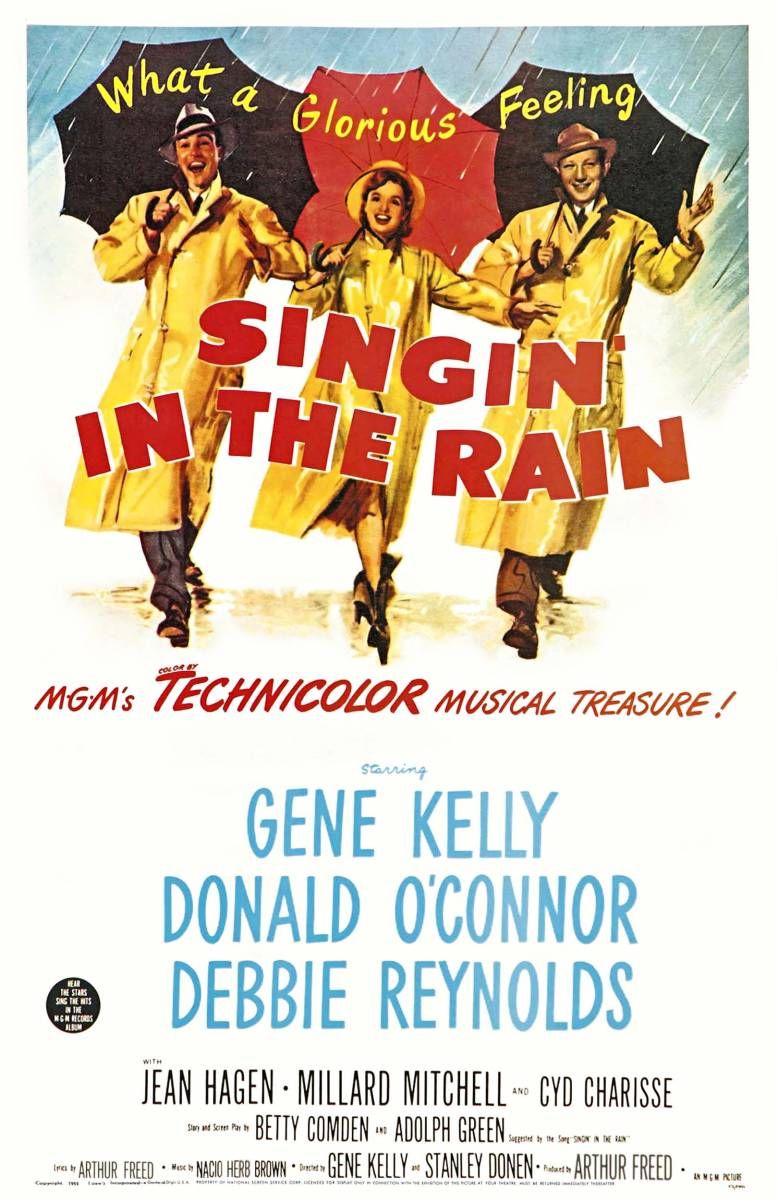
Singing In the Rain: 1952

Release date: April 11, 1952 (USA)
Directors: Stanley Donen, Gene Kelly
DVD release date: March 26, 1997
Running time: 103 minutes
Music: Nacio Herb Brown, Arthur Freed

   The Musical is an interesting piece of cinema, isn't it? It can manage to tell a story the traditional way, and still manage to stop time for a moment to emphasis a certain aspect of the film like "their in love" or "these guys really hate each other."  There are good examples of how people can transition into song, and the quality of it, there are some better examples of it, and then there are some down right ROTTEN examples of it.  Fortunately, the film we are looking at today is one of the better examples.  This is the magnum opus of musicals, The piece de resistance of performances, quote on quote, "MGM's Technicolor Musical Treasure," "Singin' in the Rain!"


   What is it that I find irresistible about this film, where I can't leave it alone, and choose to watch it again and again?  Is it the choreography, or the story?  The music, or the characters? Well, it's all of them!  Everything, is top notch, but lets go through everything just to give it a once over.  The story was my main attraction to the film, because that's exactly what it was about!  Making movies, and the transition, as well as strain actors had to go through with the invention of sound in a film.  Every studio was pitted against each other in a mad race to reach the new era of film first.  To create the first talking picture!  And it was this story line that the actors could thrive in.  And thrive they did!  Gene Kelly, Donald O'Connor, and Debbie Reynolds had no trouble carrying this film and it's two Oscar nominations.  The funny thing about the characters in this film is that everyone is where they should be.  Gene Kelly is the main character, Donald O'Connor is the supporting actor, and Debbie Reynolds is the love interest.  However, when they're all together these characters become equal in every way.


   Well, that does it for my review.  As for the rest of the story, I'd have to say it's a very educational experience, for me and film junkies alike.  In fact, this was probably the first film I ever saw that would teach me about the technical hardships of the ever expanding film business.  I learned allot, and I must not have known it, but I was watching the first educational film I'd ever like in a long while.  But aside from engaging story, "Singin' in the Rain" is adorned with amazing songs, choreography, characters, and amazing dance numbers.  There is and incredibly fluent nature with the story that is mirrored through every twirl, tap, and leap throughout the film.  It's a talented experience, with an overwhelming aura of abstraction, especially nearing the end of the film.  Not to mention, "Singin' in the Rain" is an interesting character study for the film industry, and the many attempts to transition in to the world of sound.


Watch Trailer Here (Note:  All songs are in this trailer)
  Next Review:  Batman 1989


Monday, June 18, 2012

Touch of Evil: 1958

Release date: April 23, 1958 (USA)
Director: Orson Welles
DVD release date: October 31, 2000
Cinematography: Russell Metty
Music: Henry Mancini


   The genre of Film Noir has, like other genres of film, recognizable features.  Dark alleys, lonely street corners, detectives, mystery, murder, shadows, and the femme fatale, who can sometimes be more dangerous than the case itself.  This genre was very popular during the 40's and early 50's.  However, during the year of 1958, Film Noir was not as popular as before.  Film viewers found it a bit strange when Orson Welles directed his tribute to the genre titled, "Touch of Evil." The film was based off of the novel, "Badge of Evil" and would once again ignite the flame that was and always shall be, Black Film.

   "Touch of Evil" is a story about a narcotics investigator, Mike Vargas (Charlton Heston) stumbling across a murder case involving a family of gangsters in the town of Los Robles.  He teams up with the local detective, Hank Quinlan (Orson Welles), but later finds that Quinlan is not to be trusted with.  The setting of Los Robles is a refreshing take for a Film Noir.  I think there are allot of different settings that would would prove to be quite interesting.  Big crowded streets, desolate hotels, loud tattered nightclubs, and lone, dark apartment floors.  I'm very glad that Orson Welles used this kind of setting for this kind of film.  I think it creates a different kind of an experience of viewers accustomed to these recognizable features.  This way allot of new suspense is added, towards the situation Heston is put in.  I approve of this new re-imagination of the Film Noir setting.  

   The lighting in this film is incredible (most Film Noir's are).  I know that there are films that have this kind of technique, but I'm gonna write about it like Iv'e never seen it before.  Welles did his homework with the lighting in this film.  The camera is positioned so that the shadows are clean, and cutting across the scene.  This is a sign that the condition of the light is very healthy.  There is not one scene where some form of lighting isn't used.  One of the reasons that you can tell that the film is a tribute to other Film Noir's is because of the various styles of lighting throughout this film.  Dark shadows on characters eyes, or hiding their whole face, characters moving through slits of light to make a dark/light contrast, etc.  

   For a film made as a tribute to its genre, It really seems like "Touch of Evil" stands on its own when it's put next to similar classics, such as "The Maltese Falcon."  It shows that a film can be as dark as any other film of this genre, in almost any location, being that the film is set in a town on the Mexican Border.  It succeeds in being chilling, but more importantly, it succeeds as a Film Noir, in every definition of the term.  Orson Welles had been ridiculed several times during his career in the film business, especially with "Citizen Kane" which we can all recognize now as his magnum opus of films.  This film not only surpasses the proof that Orson Welles knows Film Noir, but film itself.

8.5/10 

Watch the Trailer
Next Review:  Star Trek 2009

Tuesday, January 3, 2012

Tales of Frankenstein: 1958


   "Tales of Frankenstein," was originally meant to be a television series during the late 50's.  However, it never really picked up to get many episodes, so the only item remaining from the series is one pilot episode.  This episode is roughly around 30 minuets long, and if your lucky, you may be able to find it on DVD with the film, "The Terror" included make it a double feature.  If you would like to learn more about, "The Terror" starring Boris Karloff and Jack Nicholson click here.  Now, I don't expect this to be great, or even good for that matter, but I will try to review this strange piece of work existing in it's own world, of 1958.  Enjoy.


    "Tales of Frankenstein," reminds me of a collage short film simply meant to pay homage to a horror titan.  However, it is certainly not fit to be a television show.  There is nothing to hook any viewer by that doesn't share the general knowledge of the Frankenstein monster.  And, if anyone did, they would surely find a few minor flaws or find it too boring to continue watching.  I'm sure that the director wanted this to be so much more than it became, but alas, the shows fame had fallen short of causing any kind of impact in the film industry.


    It's quality in all forms is very similar to a movie made for television, where it's in over its head.  There are vaguely  explained reasons for things, if there is any explanation at all.   Max Halpert does not explain what it is he is dying from, and neither does his wife.  There is no suspense to peril that is unexplained and not seen.  I don't really even care about Max because I don't even get to know him well before he dies.  


   It's a fatal flaw in film, where whoever's explaining something vital to understanding the story, does a crappy job of doing it, and now the viewer is out of it because he doesn't know what the @#!*% is happening!  It's way too fast and explains too little, but maybe there is a reason to why the episode was made that way.  If it truly is a T.V series, then maybe the director wanted the information to be spread out.  It's too bad he didn't get the chance though becuase without the other episodes made, it kinda just looks like the guy half-assed it.  


   This was a poor mans Frankenstein, but the atmosphere was sufficient.  I like it when you can see how everything is created in a film.  It gives it a home made feel, rather than a sterile and synthetic one.  Although not professional, it gives the episode a nice touch.  Film is a form of expressing one's self.  Who is it to deny that one persons vision is adequate, and another one's isn't?  Well I'll tell you who...me!  It's a critics job to do that! Now, I know what you may be thinking.  "Albert!  Albert!  You reviewed two things that aren't technically horror films.  What gives?"  Well i'll tell you what gave.  I'm thinking about branching out with what it is that I review.  Maybe it'll be television, or maybe something else.  Or I might just stick with what I already have.  It just a matter of time. 


6/10


Next Review:  Wonderful Wizard of Oz  1910


Saturday, October 1, 2011

The House On Haunted Hill: 1959

 
   The review you are about to read is of the first horror movie that I've actually already seen.  This was awhile ago, and might have been before I even started reviewing horror films.  If you are new to my blog, then it might be helpful to tell you that I never usually re-watch a movie, I only see it once.  So, the fact that this review is for a movie I've already seen before hand, make this quite a rarity.  And for today's review we have something very special, "The House on Haunted Hill".  Thank you, and enjoy.

   Although horror is a genre of film, literature, and generally any other form of entertainment, among film, horror can be a very versatile subject.  There are libraries of horror footage that go from Expressionist to Psychological, Slasher, Supernatural, and the list goes on and on and on!  What I would classify this film to be is one of the more fun one's.  This was because of one man, William Castle.  He had many roles in the film business, but the job he was most known for was turning the movie theater into a haunted house.  In the movie, "The Tingler", the theater seats were rigged with back vibrators.  The plot followed a scientist that figures out about a creature living inside our spines called, "The Tingler".  Apparently the creature grows when someone is scared.  Fortunately, there is a represent to keep the tingler from growing, which is screaming.  


William Castle's introduction for, "The Tingler"


  But you’re not reading this because of, "The Tingler" (But to those of you who are, don't worry, that review isn't far away), your here to read my review of, "The House on haunted Hill".  I just wanted to give you an idea of the impact William Castle made on people everywhere which revolutionized the theater business as we know it.  Anyway I'm so glad that I'm still reviewing and haven't given up, and the reason for that is because of you.  I'm so happy for those of you who enjoy reading my blog, thank you.

   Eccentric millionaire Frederick Loren and his fourth wife, Annabelle, have invited five people to the house on haunted hill for a "Haunted House" party.  Whoever will stay in the house for on night will earn ten thousand dollars each.  As the night progresses, all the guests are trapped inside the house with ghosts, murderers, and other terrors.

  Alright, the premise seems fitting for a horror film, but is that all a horror film needs?  Of course not!  In a sense it has everything one could want, a haunted house accompanied by Vincent Price, where all things scary known to man reside.  But the problem within this equation is the fact that the characters that are guests in the house seem level headed and it wouldn't seem that the supernatural goings on in the house would frighten them so easily(with the exception of one scene:  25:25).  Onto the effects, which are okay considering the time period.  However where the effects usually enhance the atmosphere, this film's effects make it seem less credible that such a haunted house exists.  Speaking of the actual property, look at the house!


   This looks more like a warehouse than an actual haunted house!  I know that you could call this, "mixing things up" because of the new design, but everything else in the movie people have already seen in any other haunted house flick.  At least they managed to stay far away from the outside of the house and focus on the inside.  As for The acting, it was good, but stereotypical.  Even Vincent Price is played off as a side character at most times.  Most of the time the story focuses on the survival of the two most attractive people in the story, Lance and Nora.  It’s really sad when the object of love is only shown when two attractive characters stand close to each other and talk.  It’s very clear that the director wanted us to feel this way about them, even though there is no intimacy whatsoever.  

   The rest of the cast is somewhat forgettable and even one character, Ruth Bridges only has around five lines in the entire movie, and she doesn't even die!  I don't know what the audience is supposed to think of this.  As for me, I know that the film is probably one to be taken seriously, but some parts are very confusing towards what your reaction is supposed to be.  Two of the guests, Lance and Nora, travel down to the cellar to go exploring.  They come across a hollow opening and one of them leaves the other alone.  The guest left behind turns around to find an old lady making a face behind her.  The sequence of actions went as follows:  you jump out of your seat; you laugh hysterically, and then remain perplexed as to the event that had just occurred.  It’s probably the only jump scene you'll have to worry about, the only problem with that is that there are a whole bunch of other jump scenes that you don't jump to, so this scene is the only one that I'm counting.  

   Even the events that occur are confusing because you suddenly realize through the movie, that everything that happens that's scary is just filler until another clue shows itself to unravel the mystery a little further.  It doesn't even seem like a party!  From the look of things there's nothing to do given the amount of guests, and it’s pulled off as amusing to the guest of honor, Vincent Price's wife.  Speaking of Vincent and his wife, their relationship is very confusing.  They seem to be happy with each other judging by the tones of their voices but it becomes clear that they have tried to kill each other before, and that's just...creepy. There's a little bit of foreshadowing when Vincent Price is doing the role call for each guest, as if you can already tell the unsatisfying feeling he gets when mentioning his wife's name.  What I would have liked to see is the tension that would keep rising until you couldn't trust any of the residents.  Scratch that...What I would have liked to see is the tension that would keep rising until you couldn't trust any of the residents done correctly. 

To conclude this review, upon the second viewing of this film my thoughts from the beginning have changed entirely.  If your into horror for the enjoyment and don't take things too seriously, you'll like this allot.  The twist at the end was okay but it very well could have been better.  In my opinion it would have worked allot better without the twist, and just stuck with mind numbing spooks.  Instead it tried to input an intelligent plot twist to, "mix things up", but I really thought that the film could have done better without it.  I hope that you enjoyed my review of, "The House on Haunted Hill".


   I give this film 3 gliding witches out of 5 


  P.S  

   Just a little notification.  My first review was of Nosferatu on June 22 2011.  Because of the quantity of time that has passed since this review, and because of my heightening ability to analyze films, I must admit something.  My first review was a great injustice to Nosferatu.  I now know that I could have said so much more because of what I know now.  But I have to keep this review, and never change it because it will always remain a starting place to a wonderful hobby.  I want to do something about this for my 100th review, but I have a long way to go before I get there.  However the main reason I am writing again today is because this is a very special day.  Today marks the one hundred and first day that I started reviewing horror films.  Truth be told I never actually though that I would get this far.  Don't hesitate to expect more reviews after this to come.  Thank you.


  Next Review:  Little Shop of Horrors  1960